
Liya Pro stay in control, without the scatter.
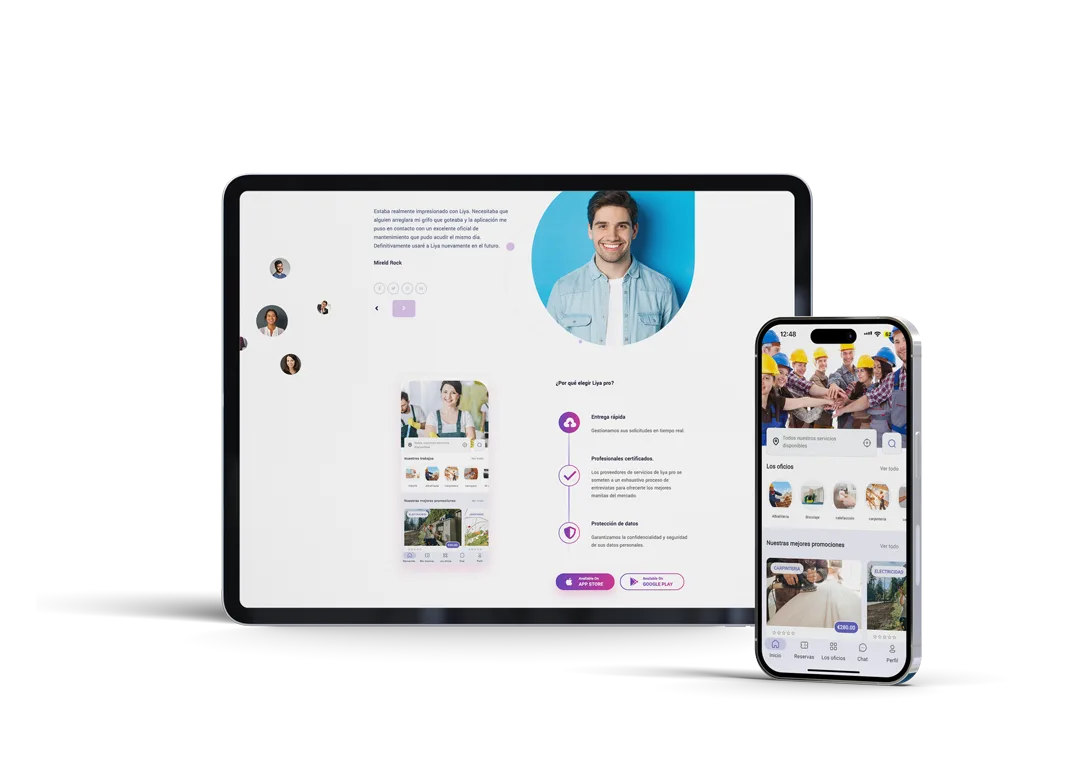
How do you give a team a single tool to run its operations and track its clients? For Liya Pro, we designed a business app that replaces spreadsheets with clear dashboards, shaped with our UX/UI expertise.
One business, too many tools.
Liya Pro was born from an observation shared by many teams: as a business grows, its tools multiply. A spreadsheet for tracking, a messaging app for exchanges, a notebook for appointments, another file for invoicing. Each one does its part, but the whole ends up costing more time than it saves, and no one ever gets a full view. The information exists, but it's scattered, duplicated, sometimes contradictory from one file to the next.
The need was clear: bring operations tracking and client follow-up together in a single tool, cut to fit the team's real gestures. Not a generic piece of software to work around, with its useless fields and foreign vocabulary, but a business app that matches the way the company actually works and becomes everyone's daily reflex. The goal wasn't to impose yet another new tool, but to make all the others disappear in favour of one. It's a difference of nature: where standard software asks the team to adapt to it, a tailor-made app starts from what already exists and respects the habits that already work.
The challenge we faced.
The first challenge was framing the right scope. A sprawling business app that tries to cover everything quickly becomes unreadable and impossible to get adopted. We had to identify the handful of functions that genuinely change day-to-day work — an overview of activity, a complete client record, task tracking — and make them flawless, even if it meant pushing back anything non-essential at launch. Discipline around scope was the key to the project. It's always tempting, when designing an internal tool, to stack features "just in case"; but every non-essential addition weighs down the interface, complicates learning, and ends up letting down the very people it's supposed to help. So we defended simplicity as a principle, not a constraint.
The second challenge was adoption. An internal tool is only worth something if the whole team uses it effortlessly, including those least comfortable with technology. Every screen had to be understood instantly, every action guided, every step obvious. Success wouldn't be measured by the number of features shipped, but by one very concrete sign: the day the team stops opening its old files, simply because it no longer needs them.
Our tailored response.
We built Liya Pro around a dashboard that gives a pulse on the business at a glance, backed by rich client records and frictionless task tracking. The app, built by our apps team, centralises what used to be scattered and turns every piece of data into something usable rather than a lost line in a spreadsheet. What used to require cross-referencing several files can now be read on a single screen.
The ergonomics were refined screen by screen with our UX/UI team: intuitive navigation, primary actions always accessible, plain language rather than technical jargon. We favoured sobriety and consistency — the same landmarks, the same gestures from one screen to the next — so the tool could be learned in minutes and mastered for the long run. A new team member should be able to become self-sufficient almost immediately, with no heavy training. We also took care over the details that reassure people day to day: fast search, a browsable history, reversible actions, so no one is ever afraid of making a mistake.
- Functional scoping and usage prioritisation
- Operations dashboard
- Client records and centralised tracking
- A tailor-made, scalable business app
The levers we used.
The project brought together product scoping, interface design and robust application development. This integrated approach, in the same spirit as our other app projects such as Rently Pro, guarantees a tool that is consistent, stable and built to last at the company's own pace. Every interface decision was made with the end use in mind, not just development convenience. We worked hand in hand with future users, confronting our mock-ups with their real daily routine early on, to fix what needed fixing before code locked the choices in. This short loop between design and field feedback proved decisive in delivering a tool that's genuinely adopted.
We designed Liya Pro as a scalable foundation: an open architecture, ready to welcome new modules and, one day, to connect to a showcase site built by our web team. A good business tool doesn't freeze the business, it grows with it: what meets today's needs must be able to expand without upending everything when the company grows or changes its methods. That capacity to evolve in stages, rather than through costly overhauls, protects the initial investment and lets value be added over time, at the real pace of the needs observed.
What we took away.
The success of a business app isn't decided by the richness of its spec, but by discipline around scope. Knowing how to say no to superfluous features protects adoption and, paradoxically, increases the tool's perceived value. This project confirms our conviction — a useful internal tool is one that people use, every day, without thinking about it and without working around it.
We also took away that a good tool is built with the people who will use it: listening on the ground beats even the best specification. Do you dream of a tool that finally replaces your spreadsheets? Discover our work or talk to our team directly.
Measurable
results.
Indicators recorded on this engagement (illustrative figures — swap in your own real data).
In pictures.
A business tool to imagine?
Tell us about your business and the tasks to bring into a single tool. We'll get back to you within 24 business hours with a first approach and a clear estimate.
- Reply within 24 business hours, no commitment.
- A single point of contact, based in Marrakech.
- A transparent budget and timeline estimate.
Discuss an app project
Reply within 24 business hours. Your data stays with us.
Request sent!
Thank you! We'll get back to you within 24 business hours.